
Publication
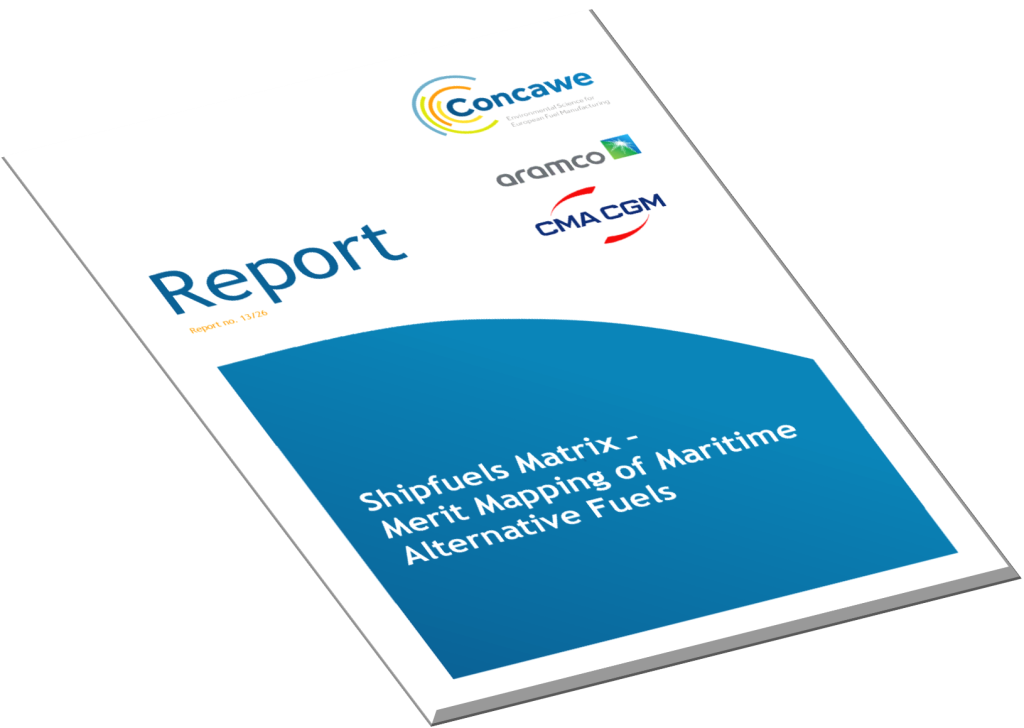
Shipfuels Matrix – Merit Mapping of Maritime Alternative Fuels
Customer
Concawe, Aramco, CMA CGMPublication date
September 2026The Shipfuels Matrix – Merit Mapping of Maritime Alternative Fuels is a data-driven resource for comparing fuel pathways that could help reduce greenhouse-gas emissions from shipping. Jointly commissioned by Concawe, Aramco and CMA CGM, the study’s research and background analyses were developed by Ludwig-Bölkow-Systemtechnik GmbH (LBST). It responds to the diversity of maritime fuels and the need for a consistent basis to assess environmental performance, resource needs, technological maturity and suitability for ships.
The Shipfuels Matrix compares complete fuel pathways rather than fuel names alone. Each links feedstock, conversion processes and energy inputs with the resulting fuel, transport and storage, and use in a propulsion system. This enables comparison by production route, supply region and maritime application. The dataset covers 46 feedstocks, 33 conversion processes, 17 final fuels or electricity options, and eight propulsion systems. Indicators include well-to-wake greenhouse-gas emissions, energy efficiency, technology readiness, feedstock potential, fuel properties, infrastructure, safety and vessel requirements.
The case studies in the accompanying report highlight why pathway-level end-to-end comparison matters: emissions depend on feedstock production, conversion and energy inputs. Some pathways can deliver substantial reductions, while others may achieve limited reductions or emissions comparable to or above conventional fuels. Options also differ in efficiency, resource availability, maturity and operational suitability. Energy density, storage, handling, safety, refuelling and ship compatibility affect practical use. No single pathway suits every application; choices depend on vessel needs, resources, infrastructure, regional conditions and regulation.
Presented through a structured dataset and highly-accessible dashboards, the Sipfuels Matrix helps users explore assumptions, evidence and trade-offs. Case studies in the accompanying report examine forest residues, pyrolysis, and ammonia versus methanol. The resource supports screening, strategic discussion and maritime decarbonisation roadmaps; it is not designed to rank fuels or replace detailed project-specific assessment. Coverage is representative, not exhaustive, and the Shipfuels Matrix is intended to evolve as technologies, evidence and regulation change.
To access the full report click Here
The tool is available Here