
LBST is pleased to share our new study commissioned by the Umweltbundesamt – German Environment Agency (UBA) on the technical and environmental implications of large-scale ammonia imports as a hydrogen carrier.
As hydrogen demand grows, ammonia is increasingly discussed as the key import vector for hydrogen. The analysis of our team at LBST together with our partners at TÜV SÜD and ILF Consulting Engineers focused on ammonia import terminals and ammonia cracking facilities, assessing both environmental impacts during normal operation and potential major-accident scenarios.
Some key findings:
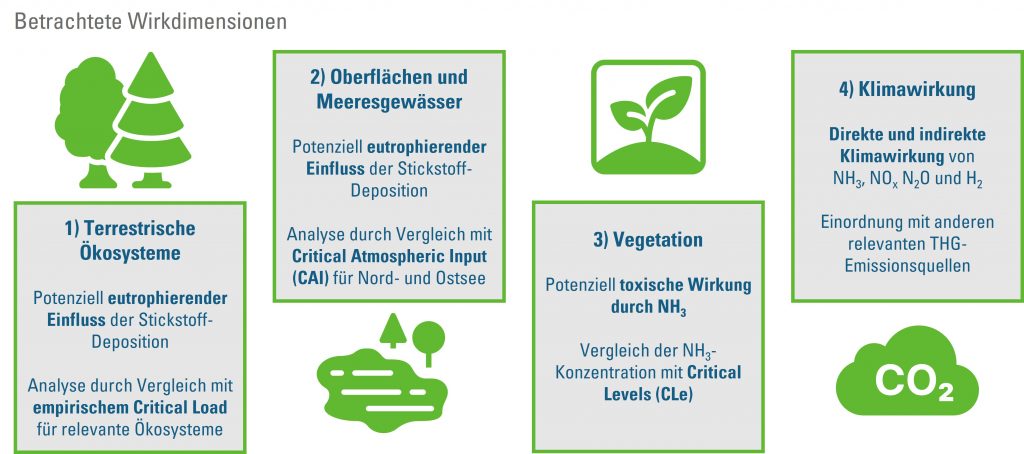
- For a limited number of new ammonia terminals in Germany, no significant additional environmental burden is expected during normal operation.
- Local impacts may still occur depending on site-specific conditions, existing background pollution levels, and ecosystem sensitivity.
- Effective mitigation and safety measures as e.g. proposed in Dutch PGS 12 can substantially reduce appropriate safety distances and the potential consequences of ammonia release scenarios – their implementation, however, comes at additional costs which may be a challenge for some business cases.
The study contributes to the ongoing discussion on how – and to what extent – ammonia can be integrated into future hydrogen supply chains while addressing environmental protection and safety requirements.
Overview of the impact dimensions examined (in normal operation)