
Publication

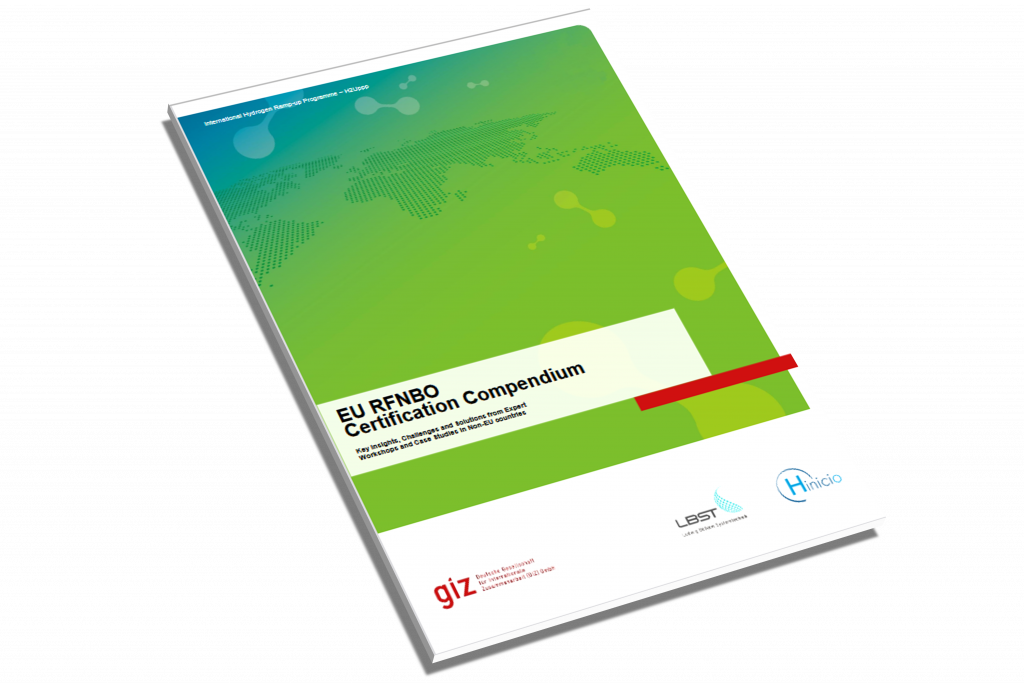
EU RFNBO Certification Compendium - Key Insights, Challenges and Solutions from Expert Workshops and Case Studies in Non-EU countries
Customer
BMEW and GIZPublication date
March 2026On the topic of certifying renewable hydrogen and PtX fuels in accordance with EU standards, LBST, together with its project partners Hinicio, the RFNBO certification scheme CertifHy and the certification body TÜV SÜD, conducted expert workshops and case studies in India, Colombia, Brazil and South Africa.
Based on the technical questions and discussion points raised during the workshops and the specific case studies, a practical guide in Q&A format was produced for project developers and regulatory authorities in non-EU countries.
These activities were commissioned by the Federal Ministry for Economic Affairs and Energy (BMWE) and coordinated by the German Society for International Cooperation (GIZ).
For hydrogen and PtX producers to obtain a certificate and thus gain access to the EU ‘premium market’ for renewable fuels of non-biological origin (RFNBO), more is required than simply knowledge of the relevant EU legislation. The requirements must be correctly implemented within the specific project and country context to ensure a successful certification process and audit.
In two-day workshops held in 2025 and 2026 in Delhi, Bogotá, São Paulo and Cape Town, in collaboration with the EU-recognised RFNBO certification system CertifHy and the certification body TÜV SÜD, relevant topics were discussed with participants alongside an explanation of sustainability requirements and greenhouse gas calculations for RFNBO certification, as well as the audit and certification process.
The key findings and insights are summarised in the RFNBO Certification Compendium in a Q&A format.
These include, for example:
- Interpretation of the ‘no-support’ clause
- Definition of ‘bidding zones’ in non-EU countries
- The role of storage
- Definition of ‘relevant’ and ‘non-relevant’ energy input
- Recommendations for effective preparation for certification
- Recommendations for national authorities to provide optimal support to project developers for certification.
In addition, the compendium contains relevant insights into certification preparation, greenhouse gas calculations, and the challenges posed by the application of EU concepts in non-EU countries, based on three case studies from Colombia, India and Morocco.
You can find more information and download the full study here: LINK